Why Corduroy Matters
Remember the artisans forgotten because of the Industrial Revolution.
A few months ago, I began researching fabric etymologies with the intent of compiling a collection of short histories.
The impetus to start this project was in response to seeing a shared post on social media which got the origin story of polka dots (and others) very wrong. While it was nice to see how people were eager and curious about learning history, language, and etymology, actively sharing misinformation is worse than not sharing anything.
 Ezra Butler
Similar to how the history of polka dots tells us about how excited people were about new technologies in the middle of the 19th century, the history of corduroy reminds us of how the Industrial Revolution stole the work of artisans who made fabrics by hand before the Spinning Jenny. [1]
 Ezra Butler
Perhaps worse than simply stealing the work, the Industrial Revolution caused us to forget the contributions, and even the professions, of the artisans who clothed people for centuries.
What / Who is Corduroy?
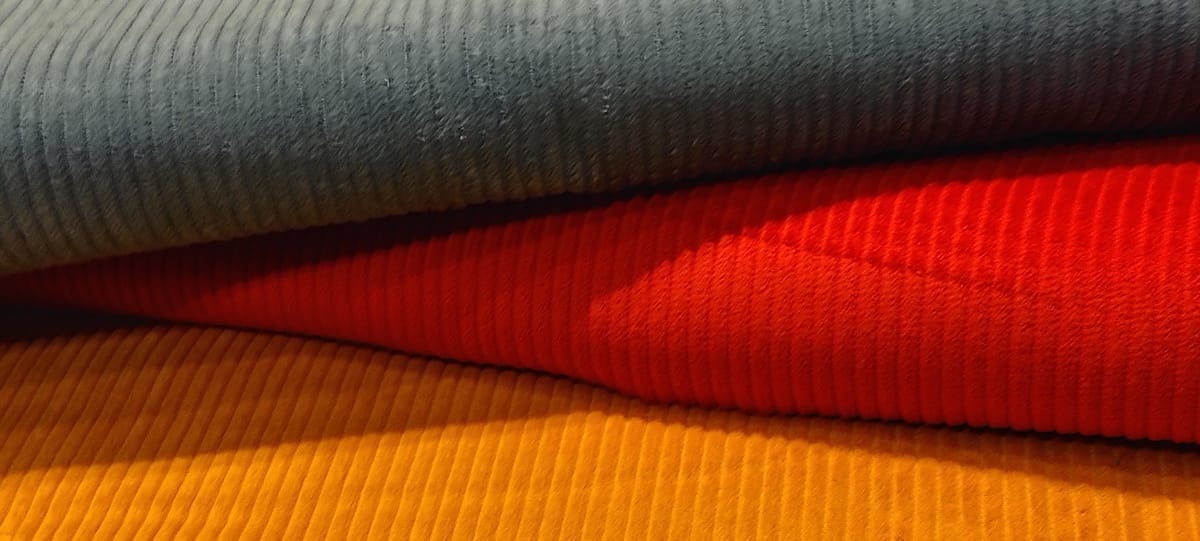
- Corduroy is a ribbed fabric containing distinct vertical ridges called cords or wales. As Cecilia from Ray-Stitch reminded me, the corduroy fabric is more a description of the stitch pattern, than of a particular material. We'll see historically, there have been corduroys from silk and worsted wool, among others.
- The name of a beloved children's book about a sentient teddy bear wearing overalls made from the above mentioned fabric written and illustrated in 1968 by Dan Freeman.
Etymologies
The two standard etymologies are:
- cord du roy - the king's cords. This faux etymology goes back to the 18th century, and I've even discovered a colonial Pennsylvania newspaper advertisement from 1774 which uses this terminology. This obviously doesn't mean that this is automatically the correct answer, because people have been wrong about things for millennia.
- cord duroy - there were two distinct fabrics, one called "cord" and the second called "duroy", and somehow they became conflated or combined. I've found many advertisements which offered both cords and duroys, separately.
Mistakes
In a 1770 London advertisement, I discovered a description of "a pair of Canton or Corderoy breeches", for sale for only 15 shillings.
My gut reading is that these are silk, as China has always been associated with silk, and this may have been a sort of corded silk, or cord de soie. While everyone modern confuses the F and the long S (ſ ) in 17th and 18th century type, they forget that the long S (ſ ) also could look like a elongated lowercase r, and this is a simple understandable mistake one could make.
Royal Marketing
Similar, I've discovered 18th century advertisements for "French Cords". Historically, there have colorful associations with the royalty of a certain country.
For example, a blue cock somehow associated with Egypt would be described as Pharaonic. Or as I had mentioned during the discussion on Mandarin oranges, even though Mandarin was not a Chinese word, it was the name which Europeans associated with the Chinese ruling class.
 Ezra Butler
It's completely reasonable to assume that someone may try to elevate their French-made cords with a subtle royal reference to French royalty, as in cord du roy.
This would obviously fall out of fashion by the end of the 18th century when the French decided to wish their final monarch the most French farewell they knew how. [2]
More Likely Theory
Yet, I don't think that either one of these is correct for the general origin of the obviously corrupted term, even though throughout history it is more than likely that people did actively make those two assumptions.
Corder and Cordery
I found an early 18th century notice about drapery workers "imbezzling" [sic] fabric from "the true Owner", and how they would incur a punishment of both Whipping and the Stocks. These workers were listed as "Sorter, Corder, Camber, Spinster, or Weaver of Wooll or Yarn".
Just like a weaver produced woven goods, a corder would produce cordage, or corded goods. There were silk and worsted cords, for example. But we also see the profession of camber, who would produce cambric, a different fabric.
This is all a roundabout way to mention the French word corderie, which would be both the profession and the work-product (I think) of the cordier, who, in English, is called a corder, with work-product of cordery.
This is why, when I found an advertisement for a runaway worker who was described as wearing corduroy, it would make sense, because it would be clear to anyone see his outfit that it had been constructed by a corder, and not a weaver, for example.
Why does this matter?
This isn't about being right or wrong.
I like to think that etymologies intrigue people because they provide some sort of context to words we've known our entire lives without ever wondering about their origin.
And folk etymologies like "the king's cords" are delightful because they do more than simply give the name of a city or a process, they tantalize us with imagery of royalty wearing corduroy overalls, similar to the outfit of the fashionable ursid [3] titular protagonist of the children's book, though I would assume, without the same need for sartorial assistance. [4]
And as I alluded in the section above about royal marketing, marketeers have absolutely leaned into these false etymologies, making them as real as any myth.
Once you know that the words corder and corderie existed, it really doesn't take a massive leap to understand how the latter could easily be corrupted into corduroy, considering everything else in this newsletter, and how the corrupted name could remain for centuries, erasing the work of the artisan who created it.
Pay Attention
It also matters because this did not happen within a vacuum.
The same linguistic mistakes that were made with regard with corduroy have been made with numerous other words. By attempting to debunk a meaningless etymology, you become more keen and aware when you encounter other misinformation, or even disinformation.
Remember
The Industrial Revolution made us forget about all the people who had honed their crafts prior to some people creating mechanized versions of the them.
This is a bit like when we use the 3.5" floppy disk as a save icon, and young adults today don't necessarily know about how they came to be. [5]
While anyone over the age of 35 likely would be up in arms at the youth's lack of knowledge, the same question can be asked: What does it matter? The stylized symbol "save" has become a meaning of its own. Imagine the myths about its origin that may arise in 50-60 years time.
We become outraged when people forget our lived history, but when we are guilty of the same irreverence, we think "what does it matter?"
Notes
- Also, the etymology for "jeans".
- I'm obviously referring to Louis XVI and the guillotine.
- Ursid is a bear. I'm referring to Corduroy the teddy bear.
- The plot of Corduroy revolved around his missing button.
- I fact-checked this with an extremely educated 30 year old yesterday.
Enjoyed this post?
Consider making a small one-time tip to help support my research.